
The new reality for multinationals: AI growth amid rising complexity
The challenges today’s MNCs face:
- Harnessing AI while managing risk and trust
- Managing increased digital complexity and operational risk
- Strengthening resilience in a time of constant disruption
- Optimizing technology investments and reducing downtime while controlling costs
As MNCs accelerate their digital transformation alongside AI adoption, technology ecosystems are becoming more distributed, interconnected and complex to manage. This creates new operational risks and exposes potentially costly blind spots. In this dynamic environment, competitive advantage will be defined not simply by who is adopting AI fastest, but who can operate it most effectively, securely and at scale. This is where observability solutions come into play!
Identifying end-to-end observability solutions
The observability market is experiencing a growth spurt as organizations grapple with ever-increasing IT complexity. The market is valued at $3.35 billion this year and is expected to hit $6.93 by 2031. As a result, the growing marketplace offers more choice than ever (Mordor Intelligence, 2026).
MNCs, however, need to carefully evaluate observability platforms before committing. Alongside growth in the observability market, there has been a significant increase in vendors using the term as a marketing label. Today, positioning a product as an observability platform is often more commercially attractive than describing it as a monitoring solution – meaning that not all tools marketed as observability platforms provide true observability capabilities. On closer inspection, many still focus on specific domains or technology layers rather than delivering an end-to-end view of the entire IT estate.
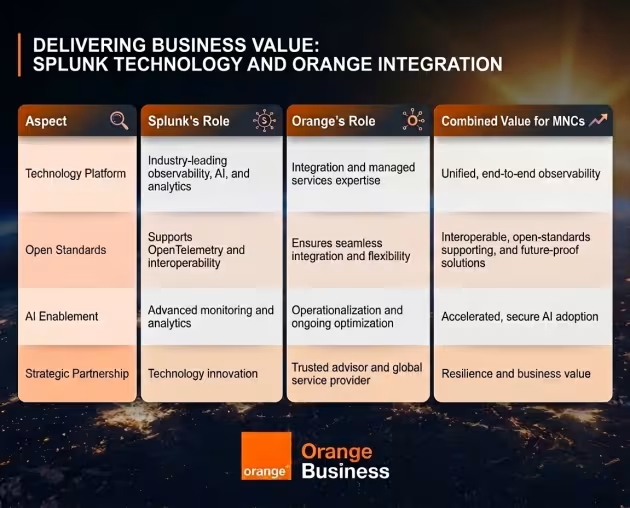
Only a limited number of providers can provide full-stack observability. For example, Splunk’s industry-leading platform, combined with Orange Business’s expertise as an integrator and managed services provider, brings together infrastructure, applications, networks, security, user experience and business context in a unified platform tailored for multinational organizations.
We are, however, seeing some consolidation as vendors acquire adjacent technologies to deliver more unified platforms. Cisco, for example, owner of Splunk, recently completed the acquisition of Galileo Technologies to enhance its AI observability capabilities and expand the features of its already robust Splunk platform.
Intelligent observability in the age of AI
Yet visibility into IT estates is only part of the broader challenge facing MNCs turning complex technology investments into tangible business value. A recent report by the Boston Consulting Group (Boston Consulting Group,2026) indicates that while 82% of CEOs are more optimistic about AI return on investment (ROI) than they were a year ago, only 6% of companies see meaningful value from AI measured in actual reduced costs and increased revenue.
The success stories are the ones that have put in place the critical capabilities to make AI work to boost efficiencies. The value does not come from a scattered AI investment approach across disconnected pilots, but from a focus on core areas that can provide competitive advantage.
Additionally, to realize the full potential of AI, organizations must first understand the internal state of their IT ecosystem. They also need greater visibility into AI use by extending traditional observability beyond infrastructure and applications to monitor model behaviors, performance, data pipelines and other AI-specific telemetry.
In a recent PWC study of operational leaders, for example, only 30% reported significant improvement in data quality and reliability, despite having stronger data foundations, while 87% admitted that poor data quality has hampered their progress in achieving value from digital initiatives. This is where observability comes in – helping improve data quality with real-time visibility into pipelines, identifying anomalies, bottlenecks, and failures before they impact downstream processes.
McKinsey's State of AI in 2026 highlights that while AI adoption has surged globally, capturing enterprise-level operational maturity and bottom-line value still has a long way to go. While AI usage is increasing, with 44% of respondents reporting they are now scaling AI across the enterprise compared to 38% a year ago, there is still a gap between adoption and operational maturity. The share of respondents reporting that AI has contributed to their organizations’ earnings before interest and tax is essentially unchanged from twelve months ago, at 37%.
Above analysis highlights the need for end-to-end observability, which provides the visibility, context and decision intelligence MNCs need to manage risk and move AI initiatives safely from experimentation to reliable, business-scale operations. End-to-end observability establishes solid foundations for managing increasingly complex technology ecosystems, delivering real-time visibility across applications, infrastructure, data, cloud environments and AI workloads. It enables organizations to reduce downtime by proactively detecting and resolving issues before they affect business outcomes, optimize technology investments, accelerate innovation with confidence and strengthen overall resilience.
As organizations adopt diverse AI deployment models – including private and hybrid clouds with edge and multi-cloud environments – comprehensive end-to-end visibility is essential to maintain consistent performance, security, regulatory compliance and trusted AI outcomes. By providing a unified view across distributed environments, end-to-end observability helps IT teams understand system health, identify risks, improve reliability and ensure AI-driven services deliver sustained business value.
+H42iven observability capabilities, integrated and managed by Orange, enable organizations to gain real-time, actionable insights across their entire digital estate, empowering them to scale AI initiatives securely and efficiently.
The rise of open source in enterprise vendor selection
The growing importance of AI is also reshaping expectations around platforms used to monitor and manage IT estates. IDC’s strategic observability market assessment identifies open-source frameworks as an increasingly important differentiator. Native OpenTelemetry integration and support for open standards are becoming essential requirements for multinational organizations seeking greater flexibility, interoperability, and cost efficiency.
MNCs are increasingly looking to leverage observability vendors that provide compatibility with open standards and seamless integration across diverse environments. As technology becomes more distributed across various cloud environments and AI-driven architectures, frameworks such as OpenTelemetry enable organizations to collect and analyze consistent telemetry data across diverse platforms. Splunk’s strong support for open-source frameworks such as OpenTelemetry, combined with Orange’s integration expertise, ensures organizations benefit from both leading technology and the flexibility to adapt as their needs evolve.
This shift also reflects a broader industry move toward open, vendor-neutral ecosystems where differentiation is moving beyond harvesting data and analytics to AI-driven insights, automation and operational intelligence.
Moving from observability capabilities to partnership value
This said, success will be defined not only by the strength of the technology platform, but by vendors becoming strategic Partners, enabling organizational change and embedding governance and efficiencies into their solutions to remain competitive in an increasingly complex digital vista.
The Splunk + Orange partnership illustrates this trend well, going beyond technology, offering multinational organizations a strategic approach to observability. With Splunk’s robust platform and Orange’s global managed services, MNCs gain not only visibility but also the context, intelligence, and guidance needed to navigate the complexities of AI-driven transformation.
In summary, the combination of Splunk’s leading observability platform and Orange’s integration and managed services expertise provides multinational organizations with a comprehensive, future-ready solution. Together, they empower MNCs to harness the full potential of AI, manage operational risk, and build resilience in an increasingly complex digital world.
Author

Patrick Pax
As Head of Digital Services Portfolio, Data and AI, Patrick Pax has extensive experience in international IT and telecommunications. Patrick and his team pioneer digital transformation strategies for major enterprises, developing advanced digital solutions that enhance operations and leveraging AIOps and IT observability to provide comprehensive oversight and smarter, data-driven decision-making. He uses a visionary approach to integrate technical innovation with practical business applications to bolster operational performance and agility.
To go further

Observability: Unlocking your competitive edge
Many technology environments are overloaded with multiple monitoring tools scattered across the IT stack, creating silos of fragmented information that stop organizations from seeing the full picture. IT teams complain of tool chain fatigue, resulting in higher costs, unnecessary complexity, delayed responses, security vulnerabilities, and integration barriers.