Communication that goes beyond voice
On industrial sites, logistics platforms, transport infrastructure, ports, airports and other complex operational environments, field teams need to be able to communicate quickly, coordinate their actions and respond effectively to incidents. For decades, walkie-talkies and professional radio systems, particularly those based on the TETRA (Terrestrial Trunked Radio) standard, have been used for critical communications among field teams. This professional radio technology is designed to enable instant and reliable group communications, particularly in environments where coordination and safety are essential. As TETRA progressively approaches end of life, by 2035, organizations need to consider how their critical communication systems should evolve and which technologies can take their place.
The market is therefore gradually moving away from traditional walkie-talkies and radio systems towards advanced group communications on smartphones that go beyond voice alone. The challenge is no longer simply to replace a walkie-talkie. It is about bringing together multiple devices and use cases: Push-to-Talk communication, DECT, digital forms, business applications and operational services. This evolution is transforming primarily voice-based communication into a multimedia experience combining voice, video, messaging, geolocation and emergency communications. This is where Frontline Worker Talk comes in.
A new generation of communications for teams on the field
Available on a large number of rugged smartphones on the market, Frontline Worker Talk takes Push-to-Talk to the next level with a Push-to-X experience. Employees can communicate instantly with their teams, but also share video, send messages, share their location or trigger an emergency alert. The efficiency of your operations highly depend on the communication between your people on the field.
A single device can progressively bring together several functions previously spread across different devices: walkie-talkies, DECT handsets, paper or digital forms and business applications. The aim is to simplify the experience of field teams while giving them access to comprehensive information and services whenever they need them: steady communication with one or several intervention groups, mission order, checklist and procedure to perform on site, remote assistance, etc…
From Push-to-Talk to Push-to-X: from voice to action
With Push-to-X, communication is no longer limited to voice. Teams can use different communication modes depending on the situation:
- Push-to-Talk (PTT) to communicate instantly with a group;
- Push-to-Video to share a situation in real time;
- Instant messaging to quickly share information;
- Geolocation to locate team members;
- Emergency communications to trigger alerts;
- Digital forms and processes to digitize field operations;
- Lone worker protection through emergency and location-based features.
The APIs (interfaces that enable different applications to communicate with one another) and SDKs (software development kits used to develop and integrate new features) also make it possible to integrate the solution into the existing ecosystem and progressively connect communications with business tools and processes. The solution includes features such as video, messaging, Push-to-Talk, VoIP calls, conferencing, screen sharing, digital forms, geolocation and emergency services. The Push-to-Talk (PTT) feature enables instant communication within one or several private groups, while voice calls over the Internet (VoIP) enable one-to-one communications towards the outside.
One application, one rugged smartphone
For field teams, having multiple devices can quickly become a burden: one device for communication, another for telephony, paper forms for certain processes and different applications for business-related tasks. Frontline Worker Talk offers a simpler approach: one rugged smartphone for multiple operational uses. This convergence can help replace or consolidate some of the uses traditionally associated with walkie-talkies, DECT handsets used for wireless business telephony and paper-based processes. The aim is to provide a single device for multiple uses while retaining the features required for field operations. This approach brings together Push-to-Talk (PTT), DECT telephony and digital forms on one device. For organizations modernizing their legacy communication infrastructures, the challenge is therefore both technological and operational: simplifying equipment while enhancing communication capabilities.
Mobile Private Network as the connectivity foundation
For critical environments, connectivity is a key component of effective communication. A Mobile Private Network (MPN) can provide a dedicated connectivity infrastructure for a site, with mechanisms for ensuring quality of service and traffic prioritization at all times over other usages. Combined with Frontline Worker Talk, it provides a suitable foundation for communications and operational use cases that require controlled and reliable connectivity.
This combination is particularly relevant for critical communications. When an employee needs to trigger an emergency communication, the priority is to transmit the necessary information to the relevant teams as quickly as possible. With Push-to-X, this information is no longer limited to voice. It can also include video, location data and other useful information like automatic pick up and surrounding noise that can help teams understand the situation and take action.
The supporting material highlights this approach, with the Mobile Private Network as a common infrastructure, enabling different use cases and providing reliable, secure and prioritized communications. The MPN provides the connectivity foundation. Frontline Worker Talk provides the communication capabilities. Together, they offer a new approach to critical communications for field teams.
A common foundation for multiple use cases
The value of a MPN goes beyond communications. A common infrastructure can also support a range of operational use cases and enable organizations to progressively evolve their services. This convergence of network, communications, devices and applications opens the door to many new use cases, including intervention management, maintenance, security, geolocation, lone worker protection, digital forms and video sharing. Organizations can therefore progressively move from a model based on multiple networks and dedicated devices towards a more unified approach. The presentation particularly highlights the convergence of OT and IT networks, as well as the possibility of using a single device for different use cases.
When every second counts: the airport example
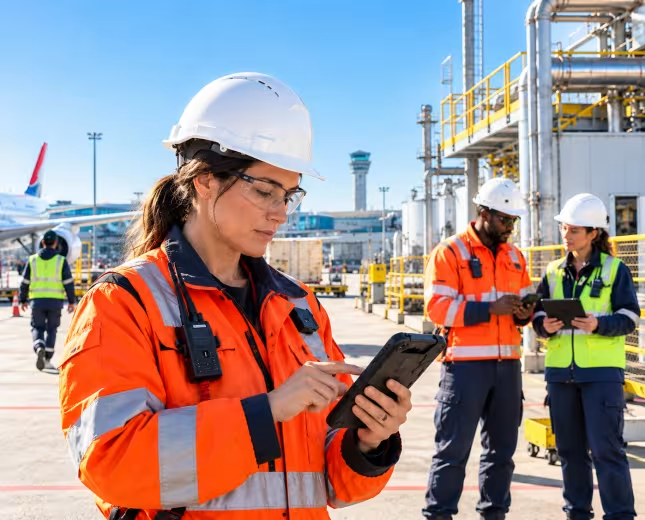
Airports are a particularly relevant example of these complex operational environments. Ground teams, maintenance, security and operations need to work in constant coordination and be able to respond quickly to unexpected events. But the same challenges exist across many other sites: factories, refineries, logistics platforms, transport infrastructure and sensitive industrial environments.
A concrete use case
Imagine that an incident is detected in an operational area. An employee can immediately contact their group via Push-to-Talk, share a video to provide additional context and share their location. The relevant teams then have several pieces of information to understand the situation and coordinate their response. In a critical situation, the ability to move quickly from voice to multimedia information sharing can help improve team coordination.
From communications to operational processes
Frontline Worker Talk is therefore about more than modernizing communications. Thanks to APIs and SDKs, the solution can integrate with a range of operational tools and processes. The rugged smartphone becomes a gateway to multiple services, including communications, intervention management, digital forms, geofencing, geolocation and lone worker protection. This approach enables organizations to start with a communication requirement and then progressively expand their use cases according to their operational priorities.
An approach designed to evolve with operations
Frontline Worker Talk can be deployed on-premises, within the customer's own environment. Depending on the architecture selected, data can remain on the customer's site, with access restricted to the customer and authorized integrators. The solution can also support different types of devices and integrate with the existing technology ecosystem. This approach enables a gradual transformation: modernizing field communications today, then integrating new use cases and processes tomorrow.
A solution designed to integrate with the existing ecosystem
Frontline Worker Talk is part of a broader ecosystem combining software, devices, integration and services. The solution can be customized and integrated through APIs and SDKs, while different devices and accessories can be connected to the overall user experience. Tetra gateways can be used for instance to ensure a smooth transition from the legacy to the new infrastructure. This approach makes it possible to progressively adapt the solution to the constraints and specific requirements of each operational environment.
“Today, field teams need more than instant voice communication. They need access to the people, information and tools that enable them to take action. With Frontline Worker Talk, we are bringing communication closer to the operational realities of the field.”
Jérôme Cabassu — Product Manager, International Mobile Private Networks and Push-to-X, Orange Business
Connect field teams today. Prepare for tomorrow's use cases
With Frontline Worker Talk, Orange Business offers a new approach to field communications: an application, a rugged smartphone and communication capabilities that can evolve with the organization's needs. For industrial sites, logistics platforms, transport infrastructure, ports, airports and other complex operational environments, this approach goes beyond the traditional walkie-talkie. The challenge is to move from primarily voice-based communication relying on dedicated equipment to a more integrated experience combining voice, video, data, geolocation, emergency communications and operational tools. An evolution that helps simplify equipment, better connect field teams and prepare for tomorrow's use cases.
Ready to evolve your field team communications?
Discover how Frontline Worker Talk, Push-to-X and Mobile Private Network connectivity can support faster, safer and more connected field operations.
Author