The race to combat climate change is on. Decarbonization is now a critical imperative for businesses across all sectors if we are to stop the destruction of our planet’s fragile ecosystem and secure its future while mitigating the impact of climate change.
Three takeaways:
- Decarbonization is pivotal to Orange Business, driving innovation, resilience and responsible growth
- Transparency in carbon reporting is vital for identifying challenges to be addressed, tracking progress and building trust
- Eco-design and the circular economy principles guide the creation of environmentally sustainable offerings
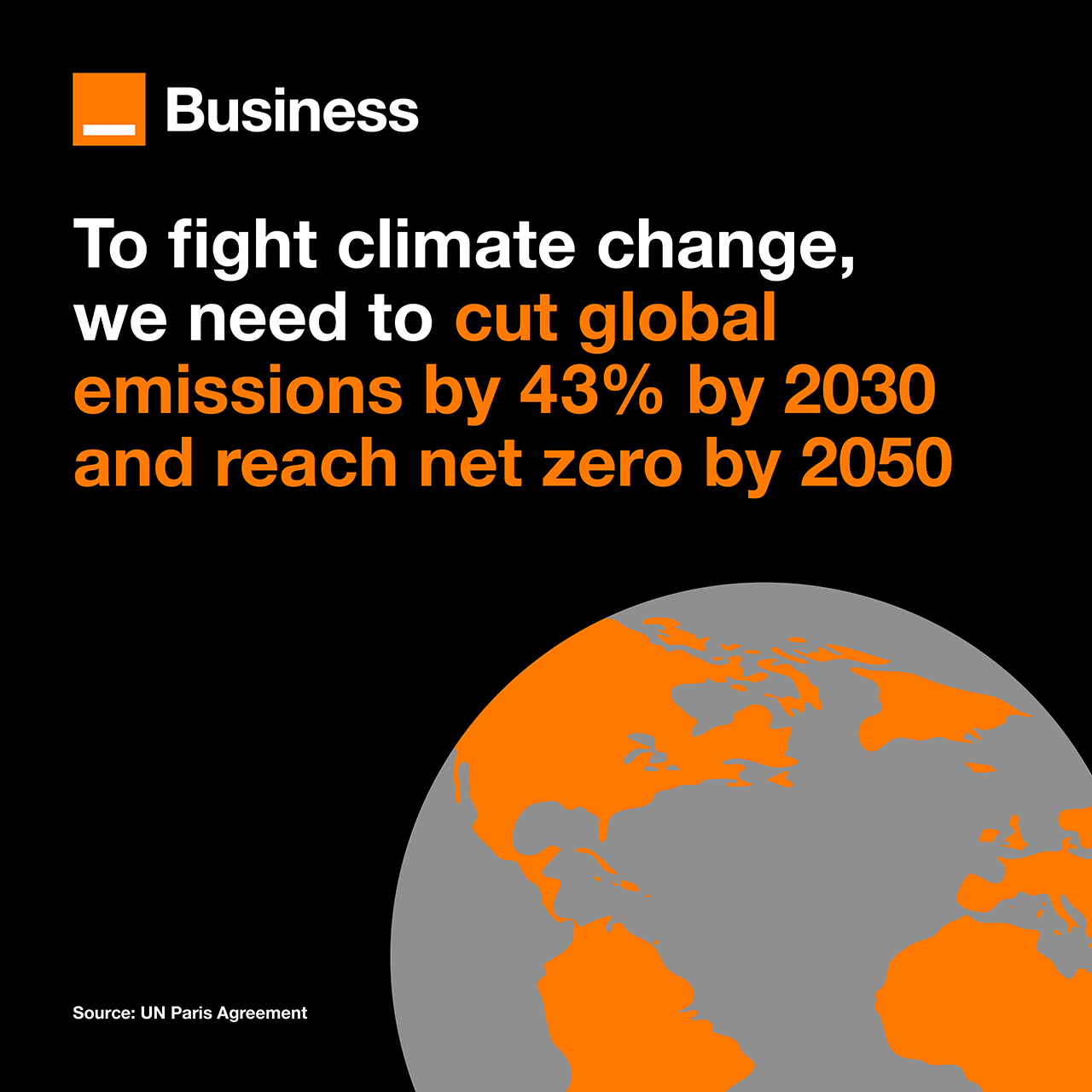
According to the United Nations, to keep global warming under 1.5°C, as outlined in the Paris Agreement, emissions must be reduced by 43% by 2030 and net zero by 2050. The technology industry has a key role in decarbonization because it consumes growing amounts of energy through data centers, cloud services and AI, contributing significantly to global emissions. At the same time, it provides tools, solutions and innovation to drive efficiencies and reduce carbon footprints across other industries.
Accelerating decarbonization efforts
Orange Business recognizes the vital role it plays in decarbonization. As digital infrastructure and AI usage expand, so do energy demand and carbon emissions. We have made decarbonization a central pillar of our business strategy. We contribute to the Orange Group efforts and its commitment to reducing CO2 emissions by 45% by 2030 and achieving net-zero carbon by 2040 – well ahead of our industry peers. By rethinking how we design, power and operate our networks and services, we can measure and minimize the environmental impact of our products, services and operations, while supporting our customers in their sustainable transformations.
Five pillars to build a more responsible digital business
Sustainability is at the core of our business strategy to proactively shape the road to a no-carbon future. To reinforce this commitment, Orange Business has implemented a carbon transition program, which we have named Carbon Journey, to reduce our carbon footprint and significantly transform our operational processes. This initiative is built around five pillars:
- Firstly, we implemented precise CO2 accounting to better understand Scope 3 emissions, representing 97% of our carbon footprint. Of these, 91% of upstream CO2 emissions are related to purchased goods and services as well as capital goods, particularly hardware. Downstream Scope 3 emissions account for 6%, while Scope 1 and 2 emissions have been significantly reduced to just 3%.
To translate insight into action, we developed a comprehensive CO2 allocation model. This tool allows us to analyze emissions by entity and business line, assign ownership within our organization, identify carbon-intensive activities and ensure our decarbonization strategies are targeted and effective. - We then projected our CO2 trajectory to 2030, integrating it with our business plan and corresponding financial forecasts. This forward-looking approach provides a practical roadmap, allowing us to identify emission “hot spots” and focus our efforts where they will have the greatest impact.
- The next step was to identify our key decarbonization levers and establish ambitious targets for each, putting together a comprehensive portfolio of actionable initiatives.
- We then implemented KPIs and tools to effectively monitor and track our carbon performance over time.
Additionally, we developed a Carbon Estimator to provide our customers with a carbon footprint calculation for the products and services they purchase from us. This allows us to demonstrate how the carbon footprint of these products and services will improve over time, thanks to our decarbonization levers and how we work with our customers on ways to reduce emissions in the use phase. - Finally, we defined governance principles, which we are progressively implementing across the organization to effectively steer our Carbon Journey and keep us on course.
By integrating environmental goals at the heart of our strategy, decisions and operations, we aim to lead by example and demonstrate that sustainability and business performance can successfully coexist. We apply the world’s most widely recognized greenhouse gas accounting standards, the Green House Gas (GHG) Protocol. KPMG independently audits our carbon figures to ensure accuracy and reliability. The Orange CO2 reduction commitments are also submitted to and validated by the Science-Based Targets initiative (SBTi).
Committing suppliers to reduce greenhouse gases
No company can work on decarbonization in a vacuum. To reduce our indirect greenhouse gas emissions, we are redefining our relationships with our suppliers and collaborating with our entire ecosystem on decarbonization. At the same time, we incorporate environmental considerations into our procurement practices by focusing, for example, on circular economy and supplier engagement.
Bringing together purchasing advisors, buyers and suppliers is crucial to achieving our carbon objectives, particularly on Scope 3. Our Partners to Net Zero Carbon (PTNZC) decarbonization initiative, built on collective development and mutual dependence with our suppliers, is designed to unify and coordinate actions relating to reducing carbon emissions of products and services we procure. The focus is on concrete actions with measurable effectiveness.
Orange and Camusat Group, for example, are working on measurable targets for reducing CO2 emissions related to Camusat’s products and services, notably the energy consumption of technical infrastructures, adoption of more sustainable materials and optimization of logistics. Read more about our collaboration with Camusat here.
Linking circular economy and eco-design
Circular economy and eco-design are closely intertwined. These are key levers to support our decarbonization strategy by minimizing waste and maximizing resource efficiencies.
Circular economy focuses on extending the lifespan of products to minimize the extraction of raw materials and reduce the energy and resources needed to manufacture new components, such as hardware equipment. Practices like refurbishment for reuse and recycling play a key role in achieving this. Complementing these efforts, eco-design ensures that products are thoughtfully designed from the start with their environmental impact in mind, covering every stage of their life cycle. Together, these approaches create a more sustainable and resource-efficient future.
Circular economy is a key driver in our sustainable operations. By implementing levers in our supply chains in France and internationally, particularly in our Managed Services activities, we have transformed operational efficiency into a tool to reduce CO2 emissions.
At Orange Business, for example, we have erased nearly 20,000 of our hard drives, verified by the secure data erasure solution Biancco. If we had destroyed these drives, manufacturing of replacements would have generated 300 tons of CO2e. There is an economic benefit to it as well. Erasing the data costs around the same as having the drives physically destroyed, while also cutting the cost of purchasing and shipping new devices. Read more about this initiative here.
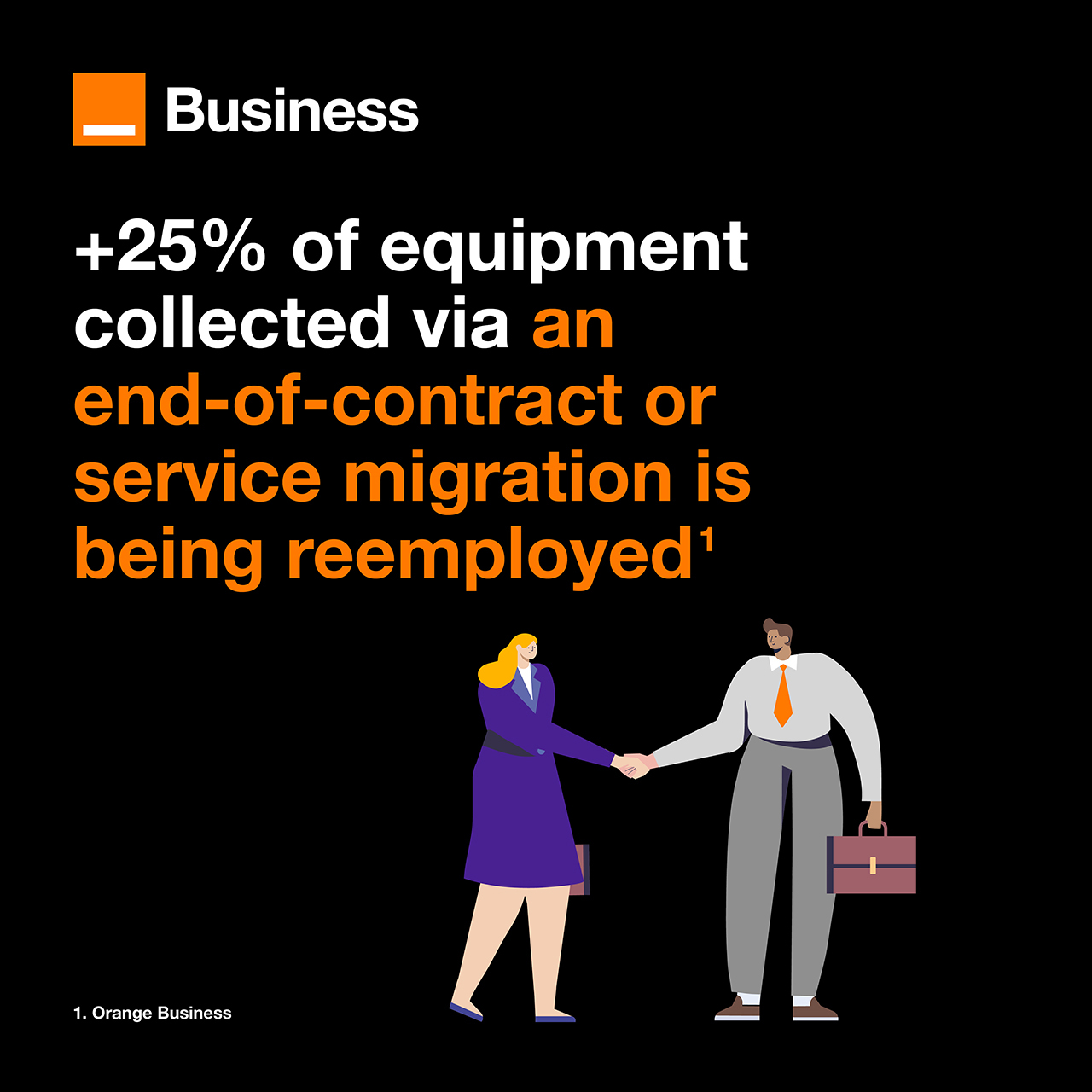
Regarding reuse, more than 25% of equipment collected following contract termination or service migration is being reemployed, avoiding at least two kilotons of CO2 emissions annually if we buy new. Additionally, we are working with suppliers to extend the lifespan of hardware and source more refurbished products.
To build on these efforts, we are exploring new ways to engage our customers, particularly through equipment resale activities. By choosing refurbished equipment, which generates up to 90% fewer CO2 emissions than new equipment, particularly due to the avoided manufacturing process, our customers can take a meaningful step toward reducing their own carbon footprint.
Eco-design, where the environmental impact of our solutions portfolio is considered from inception to end-of-life, is also central to our decarbonization strategy. We are developing new products and services like Evolution Platform in collaboration with partners like Cisco to implement responsible, sustainable practices via this approach. Read more about our Eco-Design initiatives here.
An unwavering commitment to net zero
Decarbonization is a long haul that demands a sustained approach to protecting our planet for future generations. As environmental challenges evolve, so does our resolve to lead from the front with responsible, transparent and innovative solutions to reduce our carbon footprint and empower our partners and customers to do the same.
Read more about how Orange Business is working to reduce environmental impact.

Marco Bastucci
Learn more
The Green Act program
Orange Business places the environment at the heart of its strategy with the Green Act program.
Toward a responsible and committed business model
We firmly believe that every technological advancement should benefit humanity, society and the planet. We advocate for an ethical, responsible and inclusive visualization of digital technologies.